
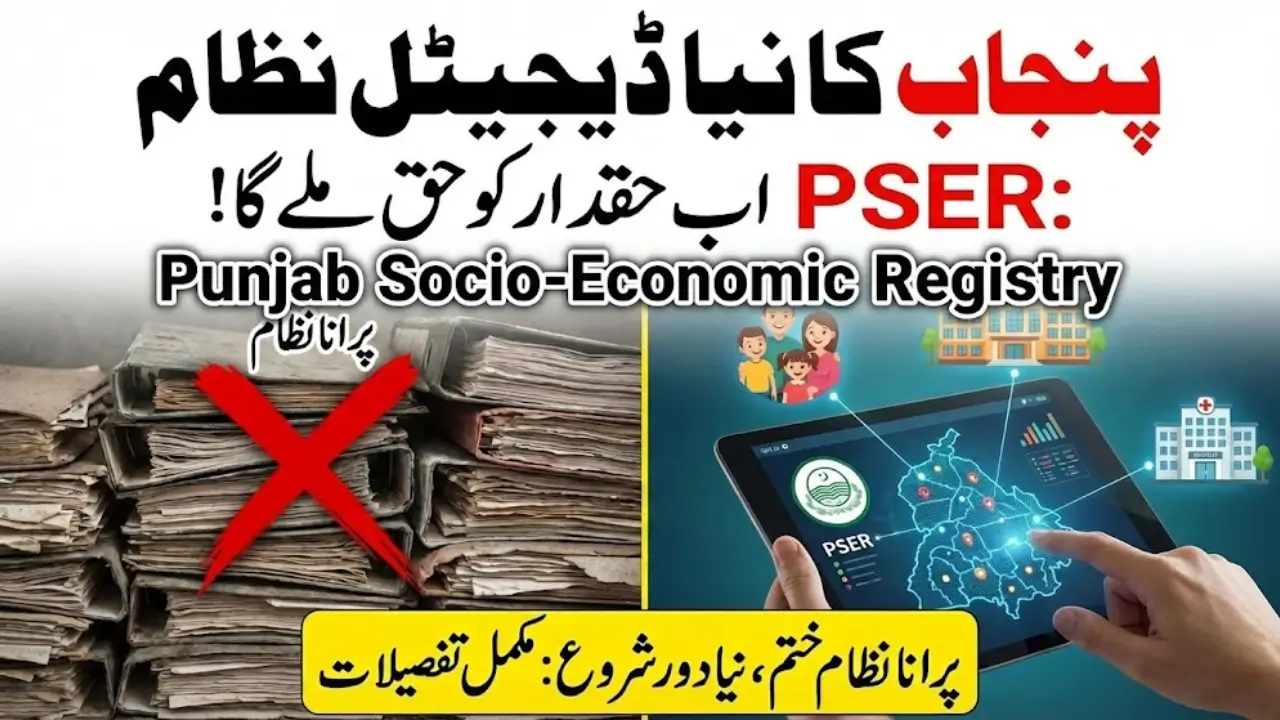
For decades, public policy in Pakistan has been shaped more by estimates than evidence. Decisions affecting millions of people were often made using incomplete, outdated, or fragmented data. This gap between reality and planning resulted in misallocated resources, ineffective programs, and public mistrust.

The Punjab Socio-Economic Registry (PSER) signals a turning point. It introduces a governance model where policies are built on verified facts rather than assumptions. This shift is not just administrative reform; it represents a mindset change toward smarter, fairer, and more accountable governance.

Understanding the Punjab Socio-Economic Registry (PSER)
PSER is a province-wide initiative designed to create a single, comprehensive database of households across Punjab. Its primary goal is to provide decision-makers with reliable socio-economic information that reflects real conditions on the ground.
Key characteristics of PSER include:

- Coverage of urban and rural households
- Standardized socio-economic indicators
- Centralized and accessible data architecture
Unlike many past surveys, PSER is not limited to one department or program. It is a foundational data system that supports multiple policy areas simultaneously.
Why Traditional Policy Approaches Fell Short
Historically, different government departments maintained separate datasets. These systems rarely communicated with each other and were often outdated by the time they were used for planning.

This led to several challenges:
- Overlapping surveys wasting public funds
- Inconsistent eligibility criteria across programs
- Policies driven by perceptions rather than needs
Without a unified and verified data source, effective governance remained difficult. PSER directly addresses this structural weakness.
You can also read: E Challan Status Check Online 2026
How PSER Data Is Collected
PSER relies on a structured, door-to-door survey model. Trained enumerators visit households and collect standardized information using digital tools.
The survey captures data on:
- Household size and composition
- Education and employment status
- Housing conditions and utilities
- Vulnerability and dependency indicators
This direct engagement ensures inclusivity and accuracy, especially for populations often missed in traditional data systems.
Digital and Technical Foundations of PSER
All data collected under PSER is digitally recorded and geo-tagged. This allows policymakers to visualize socio-economic conditions geographically and identify regional disparities.
Key technical features include:
- Real-time digital data capture
- Location verification through geo-tagging
- Automated consistency checks
Multiple validation layers ensure that errors are minimized and data integrity is maintained across the registry.
You can also read: Ministry Education of Japan, Culture, Sports
PSER as a Living Registry
Unlike one-time surveys, PSER is designed as a living registry. Household data can be updated as circumstances change, such as employment status, family size, or housing conditions.
This dynamic nature allows:
- Continuous policy relevance
- Accurate long-term planning
- Adaptation to economic or social shocks
As a result, governance becomes responsive rather than reactive.
PSER vs Benazir Income Support Programme (BISP)
A common misconception is that PSER replaces BISP. In reality, both serve distinct but complementary roles.
| Feature | PSER | BISP |
|---|---|---|
| Core Function | Data registry | Cash assistance |
| Scope | Multi-sector planning | Welfare payments |
| Role | Enables targeting | Delivers benefits |
PSER informs policymakers about needs, while BISP delivers financial support to eligible households based on defined criteria.
Proxy Means Testing and Socio-Economic Segmentation
Using proxy means testing, PSER categorizes households objectively. This removes guesswork and political discretion from beneficiary selection.
Benefits of segmentation include:
- Fair and transparent classification
- Better alignment of programs with needs
- Reduced exclusion and inclusion errors
This data-driven approach ensures that assistance reaches the right people.
Targeted Policy Interventions Enabled by PSER
With accurate segmentation, government programs can be precisely designed.
Examples include:
- Farmers connected to agricultural subsidies
- Students linked to scholarships and skills training
- Urban poor supported through housing and sanitation programs
Each intervention is informed by actual household conditions rather than generalized assumptions.
Efficient Use of Public Resources
PSER helps eliminate blanket subsidies that dilute impact. Instead, resources are focused where they generate the highest returns.
Key outcomes include:
- Reduced fiscal waste
- Higher program effectiveness
- Improved development outcomes
This efficiency is critical in a resource-constrained environment.
Strengthening Transparency and Public Trust
When decisions are based on data, transparency naturally improves. Citizens can see that inclusion criteria are factual and objective.
This leads to:
- Reduced perceptions of favoritism
- Increased trust in public institutions
- Stronger social contract between state and citizens
Trust is built not through promises, but through evidence-backed action.
You can also read: Pakistan Announces Major Reduction in Petroleum
Cross-Departmental Coordination Through a Unified Registry
PSER enables multiple departments to plan using the same dataset. This alignment reduces duplication and enhances coordination.
Shared benefits include:
- Integrated planning for schools and hospitals
- Unified disaster response strategies
- Consistent targeting across programs
The result is a more coherent governance system.
PSER’s Role in Disaster Response and Crisis Management
In emergencies, time and accuracy matter. PSER allows authorities to quickly identify vulnerable households and regions.
This supports:
- Faster relief distribution
- Accurate beneficiary identification
- Better post-disaster recovery planning
Data-driven preparedness saves lives and resources.
Institutionalizing Evidence-Based Policymaking
PSER represents Pakistan’s first large-scale attempt to embed evidence into governance structures. It moves data from the margins to the center of decision-making.
Long-term benefits include:
- Sustainable policy design
- Reduced dependency on ad-hoc surveys
- Stronger institutional capacity
This is governance built to last.
Challenges and Safeguards
Like any large data system, PSER faces challenges. Data privacy, security, and accuracy require constant attention.
Safeguards include:
- Secure digital infrastructure
- Strict access controls
- Regular data audits
These measures ensure trust and reliability.
The Future of Governance with PSER
PSER lays the foundation for inclusive growth and smarter planning. Its success in Punjab can serve as a model for other provinces.
Future possibilities include:
- Integration with health and education systems
- Real-time policy dashboards
- Nationwide data harmonization
The potential is transformative.
Conclusion
The Punjab Socio-Economic Registry marks a decisive shift from assumption-based governance to evidence-driven policymaking in Pakistan. By placing accurate, verified data at the heart of decision-making, PSER strengthens transparency, efficiency, and inclusivity. Every household counted brings the government closer to reality, ensuring that development planning reflects lived experiences rather than paper estimates. This is not just a database; it is the backbone of a more responsive and accountable state.
Frequently Asked Questions (FAQs)
1. Is PSER a welfare program?
No, PSER is a data registry that supports multiple government programs.
2. Does PSER replace BISP?
No, PSER complements BISP by providing data for better targeting.
3. How often is PSER data updated?
The registry is designed to be updated as household conditions change.


4. Who benefits from PSER?
All citizens benefit through better-designed and targeted public services.
5. Can PSER improve transparency?
Yes, decisions based on verified data reduce discretion and build trust.