
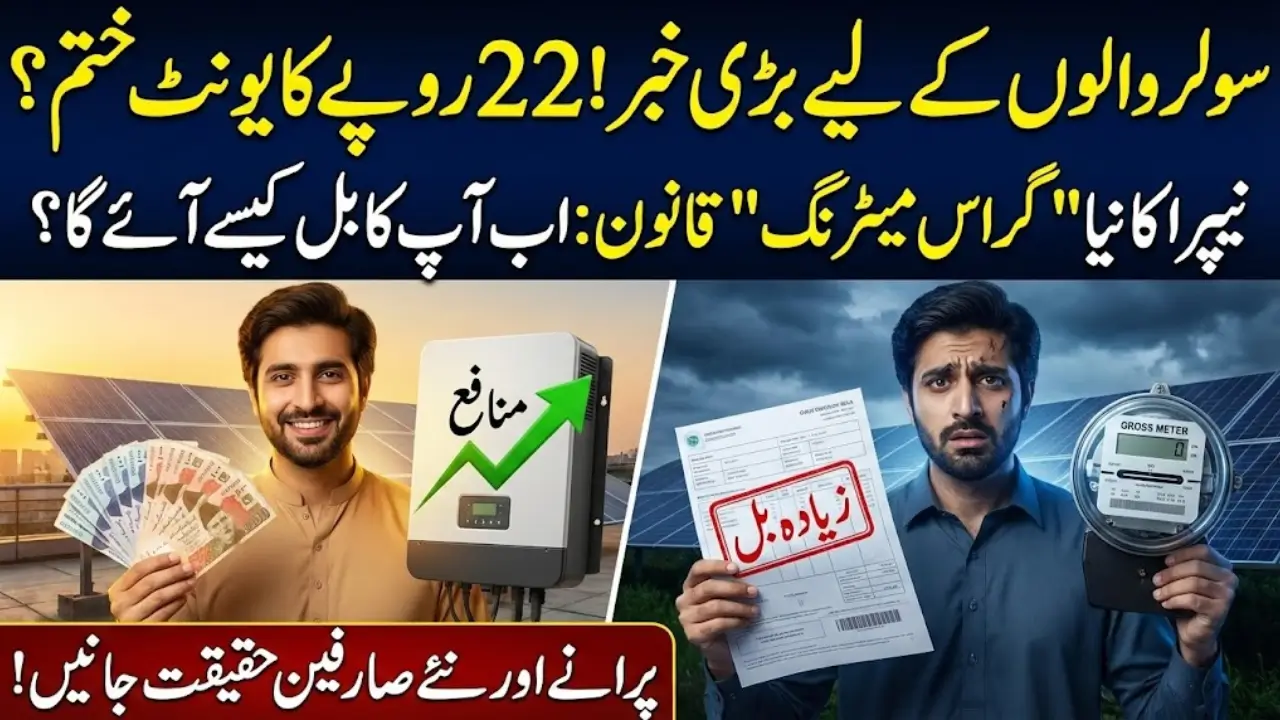
Pakistan’s rooftop solar market has grown faster than anyone expected. Rising electricity prices, frequent power outages, and falling solar panel costs pushed thousands of households and businesses toward solar energy. What started as an alternative solution has now become a major part of the national energy mix.

However, rapid growth often brings new challenges. As more consumers started producing their own electricity and selling surplus power back to the grid, pressure began to build on the conventional power system. This is where NEPRA’s proposed shift from net metering to gross metering enters the picture, marking a significant policy reset rather than an anti-solar move.

تاہم، تیز رفتار ترقی اکثر نئے چیلنجز لاتی ہے۔ جیسے جیسے زیادہ صارفین نے اپنی بجلی خود تیار کرنا شروع کر دی اور اضافی بجلی واپس گرڈ میں بیچنا شروع کر دی، روایتی پاور سسٹم پر دباؤ بڑھنا شروع ہو گیا۔ یہ وہ جگہ ہے جہاں نیپرا کی نیٹ میٹرنگ سے مجموعی میٹرنگ کی طرف مجوزہ تبدیلی تصویر میں داخل ہوتی ہے، جو کہ شمسی مخالف اقدام کے بجائے ایک اہم پالیسی ری سیٹ کی نشاندہی کرتی ہے۔
Understanding Net Metering in Simple Terms
Net metering allowed solar consumers to use the national grid almost like a storage system. Electricity exported during the day offset electricity imported at night, reducing monthly bills significantly.

Key features of net metering included:
- One meter balancing imports and exports
- High buyback rate of Rs. 22 per unit
- Faster payback period for solar systems
Over time, this structure started showing cracks. While early adopters benefited, the system began shifting costs onto consumers who could not afford solar installations.

What Is Gross Metering and How Is It Different
Gross metering changes the rules of the game by separating electricity consumption from electricity generation. Instead of adjusting units, consumers sell all exported electricity at a fixed rate and buy electricity separately from the grid.
Under gross metering:
- Exported electricity is paid at a fixed feed-in tariff
- Imported electricity is billed at normal retail rates
- No unit-to-unit adjustment takes place
This model is widely used in several countries to ensure fairness across all grid users while still encouraging renewable energy.
Why NEPRA Is Proposing This Policy Shift
The biggest driver behind this proposal is the growing financial burden on non-solar consumers. As solar users reduced their dependence on grid electricity, distribution companies faced revenue losses.
Major concerns highlighted by regulators include:
- An estimated burden of Rs. 2 per unit on grid consumers
- Revenue losses nearing Rs. 101 billion in FY2024
- Increased tariffs for households without solar access
This imbalance forced regulators to reconsider whether the existing framework could remain sustainable in the long run.
Key Highlights of the Proposed NEPRA Prosumer Regulations
The draft NEPRA Prosumer Regulations (NPR) aim to introduce clarity while protecting existing investments.
Key highlights include:
- Gross metering for all new rooftop solar consumers
- Feed-in tariff set at Rs. 11.30 per unit
- Five-year contracts with extension options
- Public consultation and feedback process
These rules are still in draft form, giving stakeholders a chance to voice concerns before final approval.
Impact on Existing Net Metering Consumers
Existing consumers do not need to panic. NEPRA has clearly stated that valid net metering contracts will be honored.
For current net metering users:
- Seven-year agreements remain intact
- Buyback rate of Rs. 22 per unit continues
- No forced migration to gross metering
This decision protects investor confidence and avoids sudden financial shocks for households that planned their systems under previous rules.
What New Solar Consumers Need to Know
For anyone planning to install solar after the new regulations are finalized, the financial calculations will change.
New consumers should expect:
- Lower compensation for exported electricity
- Separate billing for grid consumption
- Longer payback periods compared to net metering
While savings will still exist, solar will shift from being a profit tool to a cost-saving and sustainability-focused investment.
Net Metering vs Gross Metering Comparison
| Feature | Net Metering | Gross Metering |
|---|---|---|
| Buyback Rate | Rs. 22 per unit | Rs. 11.30 per unit |
| Billing Method | Unit adjustment | Separate billing |
| Contract Length | 7 years | 5 years |
| Grid Impact | High subsidy burden | Controlled financial impact |
| Consumer Savings | Higher | Moderate but stable |
This comparison shows why regulators believe gross metering offers a more balanced approach.
Financial Impact on the National Power System
Official data shows that grid electricity sales dropped by 3.2 billion units in FY2024 alone. This decline translated into massive revenue losses for distribution companies.
Long-term projections warn:
- Lost sales of 18.8 billion units by FY2034
- Financial impact of Rs. 545 billion
- Possible tariff hikes of Rs. 5–6 per unit
Without reform, these costs would continue shifting onto consumers without solar access.
Grid Stability and Operational Challenges
Beyond finances, technical challenges are also driving this change. During winter months, electricity demand drops sharply, while solar generation remains strong during daylight hours.
Grid stability risks include:
- Excess daytime generation
- Voltage fluctuations
- Limited storage capacity
Energy planners point to regional examples where uncontrolled solar expansion led to system-wide disruptions.
Misuse and System Inefficiencies Identified
Authorities have also identified cases where consumers exported more electricity than their approved system capacity.
Common issues include:
- Exporting beyond sanctioned load
- Lack of real-time monitoring
- Weak enforcement mechanisms
To address this, distribution companies are rolling out smart meters capable of controlling exports and monitoring usage accurately.
You can also read: Jhelum Electric Bus Route Timings
Why the Rs. 22 Buyback Rate Is No Longer Viable
One of the strongest arguments for reform is market reality. Utility-scale solar projects are now being contracted below Rs. 10 per unit.
Paying rooftop producers Rs. 22 per unit created:
- Price distortion
- Artificial incentives
- Unsustainable subsidies
The proposed Rs. 11.30 tariff aligns more closely with current generation costs.
Role of Government and Policy Oversight
The policy review gained momentum after a high-level meeting chaired by the Prime Minister. Authorities were directed to assess the broader impact of net metering before final decisions.
Next steps include:
- Stakeholder feedback within 30 days
- Possible public hearing
- Final notification after review
This process signals a structured and consultative approach rather than abrupt reform.
What This Means for the Future of Solar in Pakistan
Solar energy is not being discouraged. Instead, the goal is to ensure long-term sustainability.
Expected outcomes include:
- More responsible system sizing
- Reduced strain on the grid
- Balanced cost-sharing among consumers
Solar will remain attractive, but speculative installations may slow down.
How Consumers Can Prepare for Gross Metering
Future solar users will need smarter planning.
Practical steps include:
- Designing systems based on self-consumption
- Shifting usage to daylight hours
- Considering battery storage where feasible
These adjustments can help maximize savings even under gross metering.
You can also read: Sahiwal Electric Bus Route Details Step by Step
Opportunities and Challenges Ahead
For consumers, the challenge is adapting expectations. For the power sector, the opportunity lies in restoring balance.
Key takeaways:
- Solar remains valuable but not overly subsidized
- Grid stability improves
- Long-term tariff pressure reduces
Conclusion
NEPRA’s proposal to introduce gross metering marks a major shift in Pakistan’s energy policy. It reflects the reality that while rooftop solar has delivered undeniable benefits, unchecked growth under generous incentives created financial and operational stress. By protecting existing consumers and recalibrating incentives for new ones, regulators are aiming for a fairer, more stable energy future. Solar is not going away it is simply entering a more mature and balanced phase.
Frequently Asked Questions (FAQs)
1. Will existing solar users be forced to switch to gross metering?
No, existing net metering contracts will remain valid until expiry.
2. Is solar still worth installing under gross metering?
Yes, but savings will depend more on self-consumption than exports.
3. Why is the new buyback rate lower?
It reflects current market prices and reduces subsidy pressure on the grid.


4. When will the new regulations be finalized?
After stakeholder feedback and possible public hearings.
5. Does this mean the government is discouraging solar energy?
No, the goal is sustainable growth, not restriction.