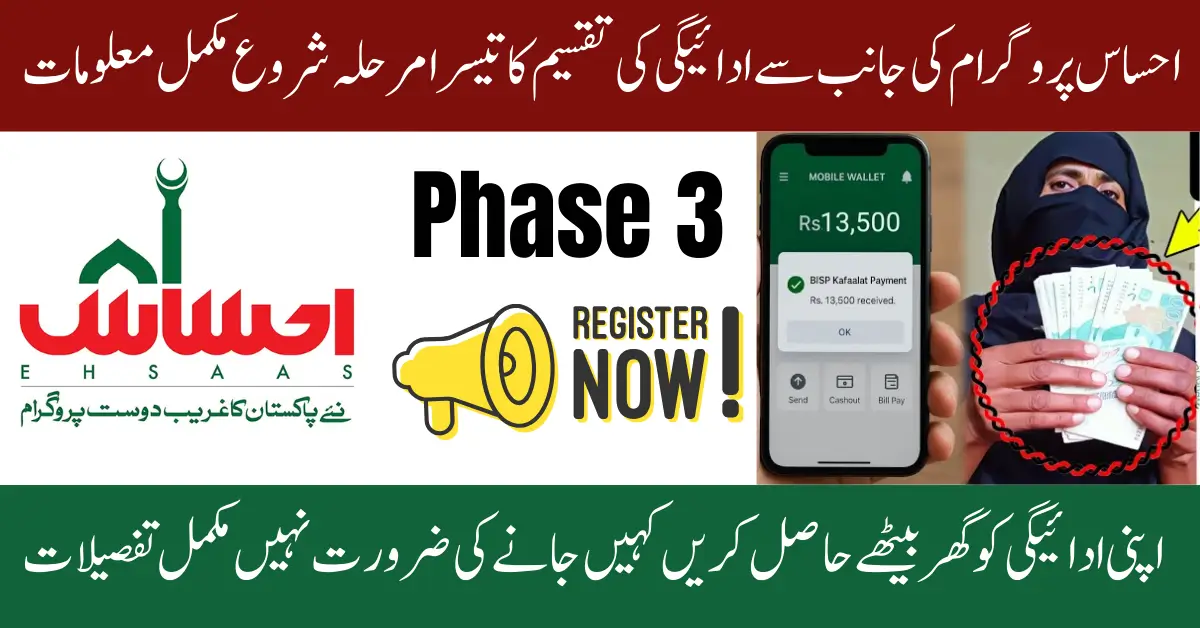
8171 Ehsaas Program Phase 3 Payments
8171 Ehsaas Program Phase 3 Payments Government of Pakistan has announced the beginning of 8171 Ehsaas Program Phase 3 payments from October 2025. This is an important update because it marks the final phase of the current cycle, especially for families who missed their earlier installments due to biometric errors, incomplete records, or technical problems. The government has decided that no genuine beneficiary should be left behind, which is why this phase has been designed to cover such cases.
The installment amount of Rs.13,500 per family will be delivered through official BISP channels including payment centers, HBL Konnect shops, and designated ATMs. In the current economic situation, where inflation is putting pressure on low-income families, this installment is expected to help in covering basic needs like food, utilities, healthcare, and children’s education. The process has been simplified, and all beneficiaries are encouraged to check their eligibility and collect their payments through secure and verified methods.
You Can Also Read: Pink Scooty Scheme 2025 Online Apply
Quick Facts About 8171 Ehsaas Program Phase 3
For readers who want the most essential details in one place, here is a quick table that highlights the key points of this installment.
| Point | Detail |
|---|---|
| Installment | Rs.13,500 per family |
| Start Date | October 2025 |
| Phase Type | Final phase of current cycle |
| Collection Method | BISP payment centers, HBL Konnect shops, ATMs |
| Beneficiaries | Families missed earlier phases due to errors or incomplete records |
This table helps you see the most important information at a glance before we move into the detailed explanation of eligibility, collection process, and common problems.
You Can Also Read: Punjab Honhaar Scholarship Phase 3 Online Registration

What’s New in Ehsaas Program Phase 3
This phase is different from the earlier two because it specifically targets families who could not receive their previous installments. In Phases 1 and 2, many households were left out due to problems like biometric mismatches, incomplete data, or “No Record Found” messages on the system. The government has now ensured that these families will get their chance to collect the Rs.13,500 installment in October 2025.
Another important update is the inclusion of mothers who are registered under the Taleemi Wazaif scholarships. This means they will not need to apply separately to receive the payment. By streamlining this process, the government aims to make sure that payments reach as many deserving families as possible. Transparency has also been improved, with all payments being processed directly through official channels.
Key updates in Phase 3:
- Final opportunity for families who missed earlier phases.
- Biometric mismatch and record error cases now included.
- Taleemi Wazaif mothers also eligible for this phase.
- Strict monitoring to ensure the full amount reaches families.
You Can Also Read: Benazir 8171 Kafalat Q-1 Installment Released
Who Can Receive the Rs.13,500 Installment
The eligibility criteria for this program remain consistent, but in Phase 3 there is more focus on families that were left behind earlier. To qualify, a household must be registered in the BISP database and meet the required poverty score conditions. The poverty score threshold is below 34%, which ensures that the support reaches only low-income families.
Apart from the poverty score, families must not include government employees or owners of luxury assets. They must also have completed CNIC verification and biometric checks. Importantly, families who have received a confirmation SMS from 8171 are considered verified and eligible for payment collection.
Eligibility checklist:
- Poverty score under 34% in the official database.
- Household registered in the BISP list.
- No government job or ownership of luxury assets.
- CNIC verified and biometric registration completed.
- Confirmation SMS from 8171 received.
How to Check Your Eligibility
Checking eligibility has been made simple so that families do not face unnecessary difficulties. The government has provided three free and official methods that every household can use. The first is the SMS service, where you send your CNIC number (without dashes) to 8171 and receive an instant reply with your status.
The second option is the web portal (8171.bisp.gov.pk). This online tool allows beneficiaries to enter their CNIC along with a captcha code to check whether they are eligible and whether their payment is ready for collection. For families without internet access, the third option is to visit the nearest BISP Tehsil Office with their CNIC, where staff can confirm eligibility and provide guidance on the next steps.
You Can Also Read: PM Electric Bike Scheme Repayment Plan
Ways to check eligibility:
- SMS: Send CNIC number to 8171 and get a reply.
- Web Portal: Enter CNIC at 8171.bisp.gov.pk to check details.
- BISP Office: Visit with CNIC to confirm eligibility in person.
How to Collect Your Payment Safely
Once your eligibility is confirmed, the process of collecting your installment is straightforward. You need to go to the nearest BISP payment center, HBL Konnect shop, or an official partner ATM. Always carry your original CNIC with you because it will be required for biometric verification.
After your thumbprint verification, you will receive the full cash amount of Rs.13,500. It is very important to collect your printed receipt and keep it safe as proof of payment. This receipt is your guarantee in case of disputes or complaints. The entire process is free, and beneficiaries are strongly advised not to pay any extra charges to anyone.
You Can Also Read: BISP October 2025 Payment Release For Complete
Steps for collection:
- Visit payment center, Konnect shop, or ATM.
- Show your original CNIC.
- Complete biometric verification.
- Collect Rs.13,500 in cash.
- Take and keep your printed receipt.
Common Problems and Solutions
Even though the system has improved, some beneficiaries may face difficulties while collecting their payments. A common issue is biometric verification failure, which can happen due to poor fingerprints. In such cases, beneficiaries should try another machine at the same location or update their fingerprints at a NADRA office.
Another common issue is the “No Record Found” error on the portal. Families facing this should visit their nearest BISP office and request a re-survey. If the payment received is less than the expected Rs.13,500, it should be reported immediately to the BISP helpline (0800-26477) along with the payment receipt.
Problem-solving tips:
- Biometric failure → update fingerprints at NADRA or use another machine.
- No Record Found → request re-survey at BISP office.
- Less than Rs.13,500 → report with receipt to helpline.
- No SMS → reinsert SIM or check online portal.
Why This Payment is Important for Families
For low-income families struggling with rising costs, the Rs.13,500 installment is more than just financial aid. It provides immediate relief for daily needs and helps families avoid falling into debt. Many households use this payment to purchase basic food supplies, pay overdue utility bills, cover school fees, or manage emergency medical expenses.
By ensuring that the money goes directly to beneficiaries without deductions, the government is supporting thousands of families in maintaining dignity while meeting their essential needs. This direct transfer system also reduces corruption and delays, making sure that the right people receive timely assistance.
You Can Also Read: 8171 Web Portal October Update 2025
Most common uses of the installment:
- Daily food and groceries.
- Utility bill payments.
- School fees and children’s education needs.
- Emergency health care costs.
Conclusion
The 8171 Ehsaas Program Phase 3 payments, starting in October 2025, represent the final chance for families to receive their Rs.13,500 installment in this cycle. It covers households that missed out earlier due to biometric errors, technical issues, or incomplete records. With easy eligibility checks and transparent payment methods, the government is aiming to ensure smooth disbursement.
Beneficiaries are advised to check their status through SMS, the web portal, or a BISP office, and then collect their payment using original CNIC and biometric verification. By following the official process and keeping their receipts, families can benefit fully from this program and use the money to manage essential needs in these difficult times.