
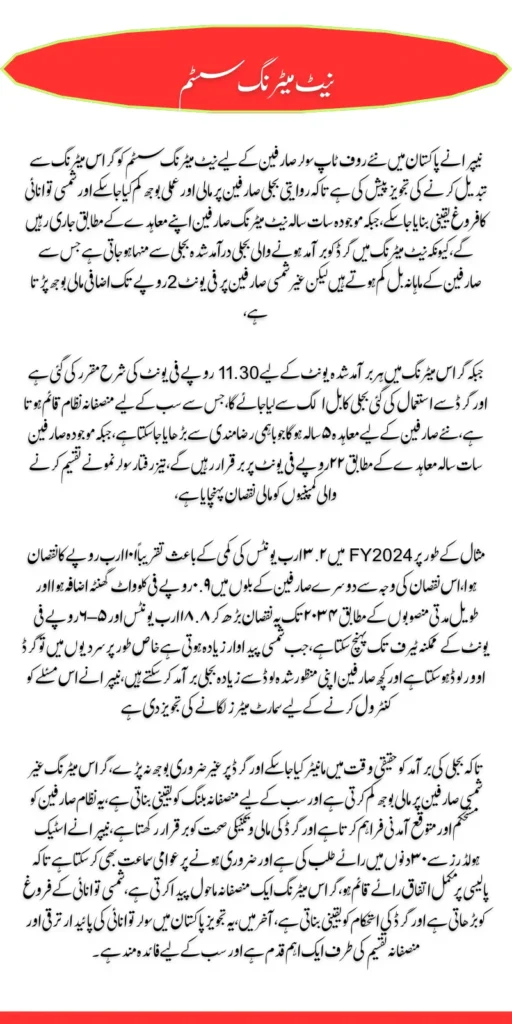
The National Electric Power Regulatory Authority (Nepra) has introduced a new proposal to replace the existing net metering system with a gross metering framework for new rooftop solar consumers in Pakistan. This shift aims to reduce the financial and operational burden on conventional electricity users while promoting sustainable solar growth. Existing net metering users with valid seven-year agreements will continue under the current buyback rate until their contracts expire.
This article explains the key changes, benefits, challenges, and implications of the new Nepra gross metering policy in a simple and step-by-step format.

Understanding Net Metering and Gross Metering
Net metering and gross metering are two systems that define how rooftop solar users are compensated for electricity exported to the grid.
Net Metering:

- Electricity exported to the grid offsets electricity drawn from it
- Reduces monthly electricity bills for solar users
- Encourages rooftop solar adoption
- Puts a financial burden of up to Rs. 2 per unit on non-solar consumers
Gross Metering:
- Solar users receive a fixed feed-in tariff for all exported electricity
- Electricity consumed from the grid is billed at standard retail rates
- Separates production and consumption charges, ensuring fairness
Key Features of Gross Metering:
- Feed-in tariff: Rs. 11.30 per unit for new installations
- Contract period: 5 years, extendable by mutual agreement
- Separate billing for grid electricity drawn
This system aims to balance the growth of rooftop solar with the financial sustainability of the grid.

Nepra Gross Metering: Key Changes for Consumers
The transition from net metering to gross metering brings several notable changes for rooftop solar users. The table below summarizes the differences:
| Feature | Net Metering | Gross Metering |
|---|---|---|
| Compensation | Reduces electricity bills by offsetting consumption | Fixed feed-in tariff for exported electricity |
| Contract | 7-year agreements for existing users | 5-year agreements for new users |
| Grid Impact | Higher financial burden on non-solar consumers | Fairer billing and reduced tariff escalation |
Under gross metering, the separation of electricity production and consumption ensures that all consumers are treated fairly, and the financial burden on non-solar users is minimized.
You can also read: NEPRA Introduces Gross Metering What It Means for Solar Consumers
Financial Impact on the Grid
Rapid adoption of rooftop solar has caused substantial revenue losses for distribution companies
- In FY2024, a 3.2 billion unit drop in grid electricity sales resulted in nearly Rs. 101 billion in losses
- These losses contributed to an average tariff increase of Rs. 0.9 per kilowatt-hour for other consumers
- Long-term projections suggest that by FY2034, lost grid sales could reach 18.8 billion units, causing financial losses of Rs. 545 billion and tariff hikes of Rs. 5–6 per unit
Officials have noted that the grid is being effectively used as a battery storage system, with solar users exporting surplus power while avoiding fixed system charges.
Grid Stability Concerns
The growth of net-metered solar capacity, currently around 6,000 MW, presents potential risks to grid stability
- Excess generation during low-demand periods can overload the system, especially in winter
- Misuse, such as consumers exporting more than their sanctioned load, could disrupt supply
- The Sri Lanka blackout serves as a warning for the dangers of unchecked solar expansion
To mitigate these risks, distribution companies are installing smart meters to monitor and control electricity exports in real-time.
Steps to Manage Solar Expansion
Nepra has proposed several measures to ensure responsible rooftop solar growth while maintaining grid stability
Actions and Purposes:
- Smart meters: Real-time monitoring of electricity exports
- Feed-in tariff: Fair compensation for exported electricity
- Public consultation: Stakeholder feedback before finalization of regulations
- Responsible installation: Encouraging rooftop solar systems within approved capacity
- Peak and off-peak management: Reducing daytime overload on the grid
Nepra has invited feedback from stakeholders within 30 days and may hold public hearings before finalizing the new regulations.
You can also read: Breaking News: E-Registration App Launches in Punjab
Benefits of the Gross Metering System
Transitioning to gross metering offers multiple advantages for both solar users and the grid
- Ensures fair billing for all consumers
- Reduces financial burden on non-solar users
- Encourages responsible rooftop solar installations
- Enhances grid stability during peak and off-peak hours
- Provides predictable earnings for solar consumers through feed-in tariffs
FAQs
Q: What is the main change in the Nepra Gross Metering Proposal?
A: It replaces net metering with gross metering for new rooftop solar consumers, offering a fixed feed-in tariff for exported electricity
Q: Will existing net metering consumers be affected?
A: No, existing users with valid seven-year contracts will continue at Rs. 22 per unit until their agreements expire
Q: What is the proposed feed-in tariff for new solar installations?
A: Rs. 11.30 per unit for all electricity exported under gross metering


Q: How will the proposal impact grid stability?
A: It aims to maintain grid stability by reducing daytime overloads and monitoring exports through smart meters
Conclusion
NEPRA’s aggregate metering proposal represents a strategic step towards the development of sustainable rooftop solar power in Pakistan. By decoupling consumption from production charges and providing fixed feed-in tariffs, the policy ensures fairness, financial stability, and grid reliability. While the transition may require adaptation for new solar users, it ultimately benefits the entire electricity ecosystem, balancing the interests of both solar and non-solar users.